01 / THE COMPLETE DEVELOPMENT PROGRAM
Understand the enterprise. Engineer across the full stack.
This program connects real business operations to the technologies needed to build, integrate, secure, operate and evolve enterprise systems. The learning path emphasizes business understanding first, followed by engineering and architecture decisions you can explain and validate.
Start by simulating a functioning company — not by picking a framework.
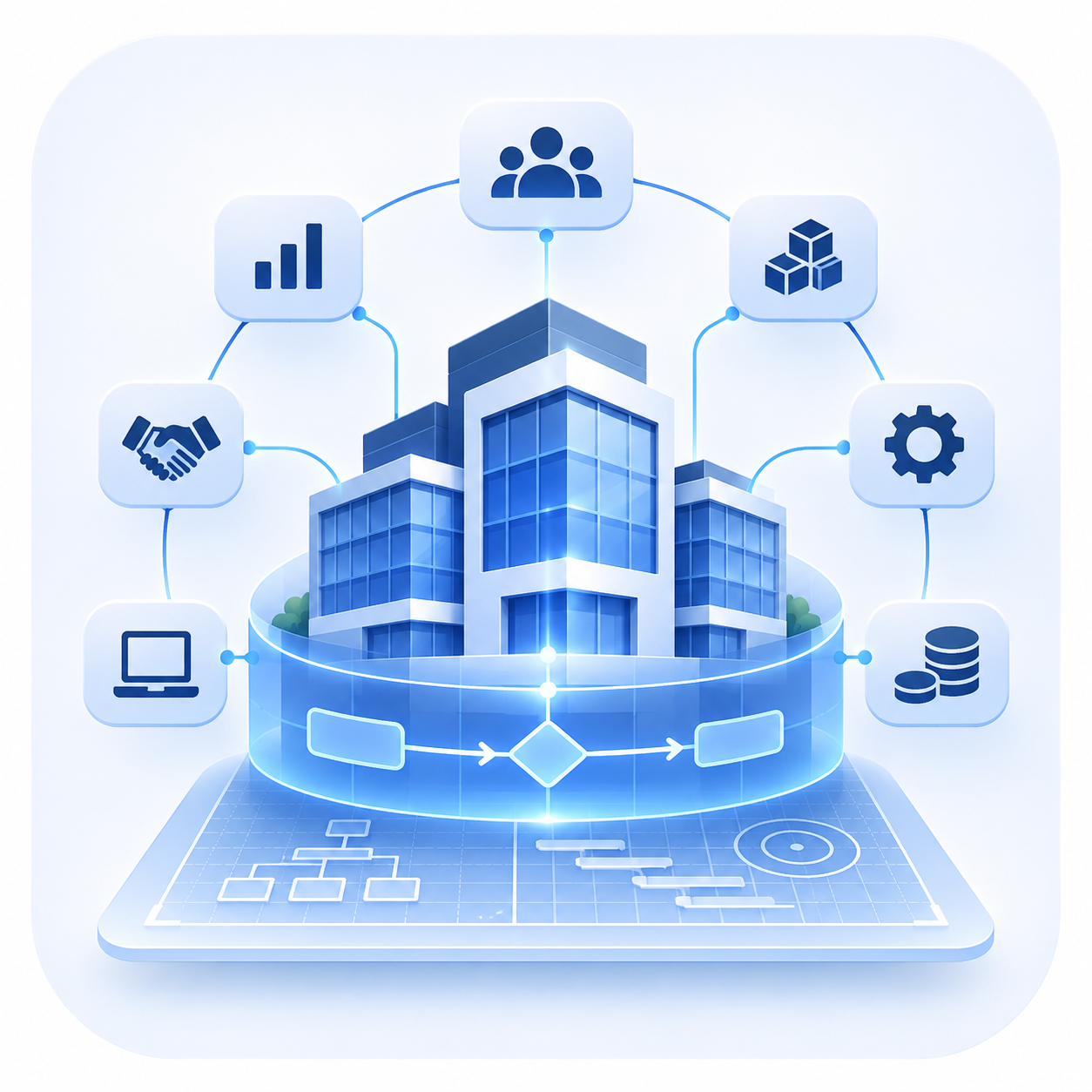
Work through business scenarios that expose how Sales, Procurement, Inventory, Finance, Manufacturing, Distribution, HR and other functions exchange information. Discover the underlying business entities, approvals, transactions and dependencies.
Then turn those discoveries into business capability maps, relational data models, secure applications, integration architectures and measurable operational outcomes.
Business-firstEnd-to-end enterprise simulations and cross-functional analysis
N-tier to distributedFrom browser rendering and APIs to messaging, microservices and cloud
Security by designIdentity, authorization, auditability and accountable enterprise AI
The following modules form a proposed curriculum. Their sequencing can be adapted to a learner’s experience and target architecture or leadership role.
MODULE 01 / ENTERPRISE BUSINESS SIMULATIONEnvision the entire company
Build business depth through realistic enterprise scenarios, from customer demand to financial close.
- Departmental operating models and ownership boundaries
- Order-to-cash, procure-to-pay, production-to-distribution
- Business events, master data and transaction lifecycles
- ERDs, normalization, entity relationships and business rules
- Business capability maps and cross-functional process flows
Practical output: Simulated enterprise operating model, process diagrams and integrated data model.
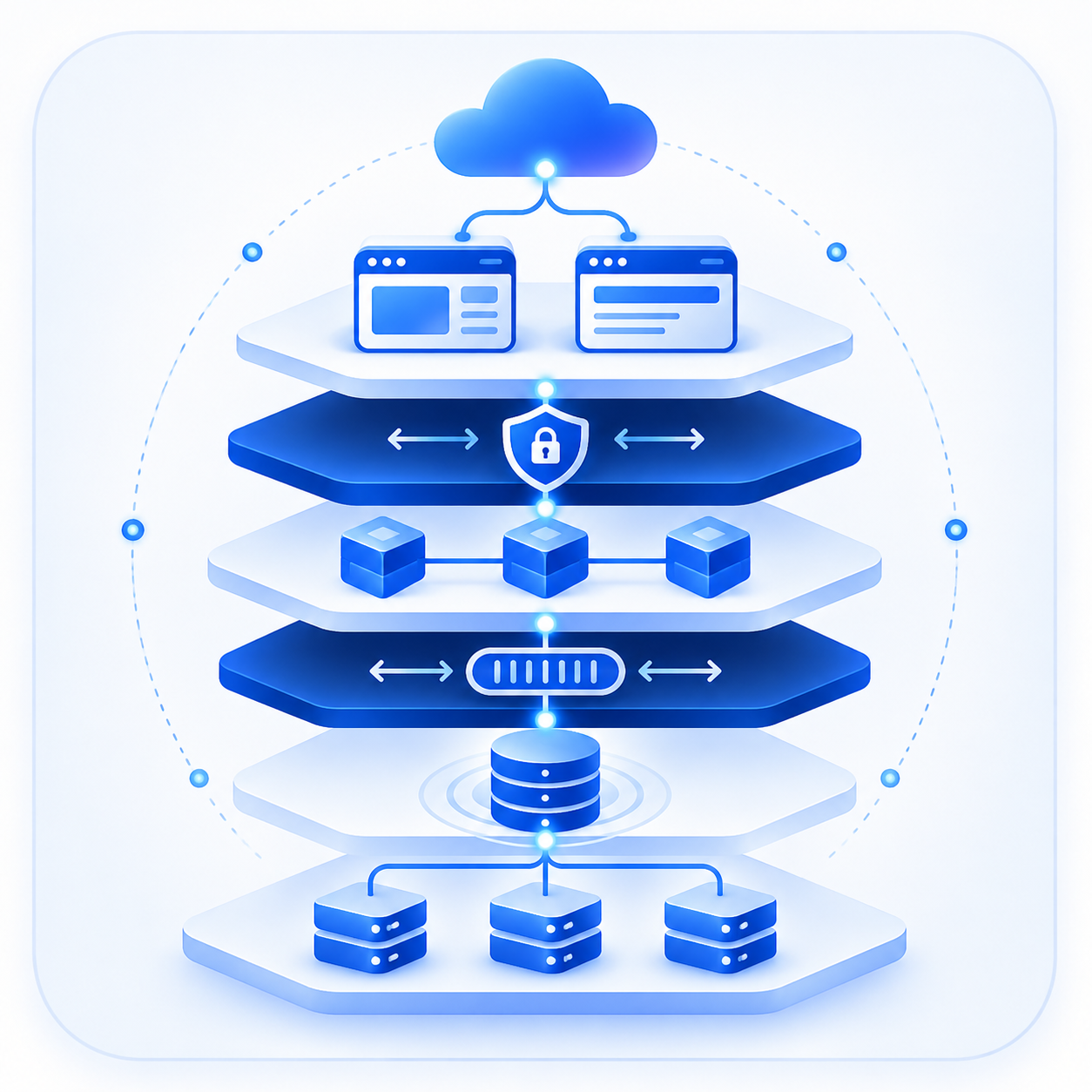
MODULE 02 / N-TIER AND DISTRIBUTED ARCHITECTUREArchitect connected systems, not isolated applications
Understand the structural decisions that make enterprise platforms reliable, maintainable and extensible.
- Presentation, API, domain, integration and persistence tiers
- Modular monolith versus distributed services
- Synchronous REST versus asynchronous event processing
- Consistency, idempotency, retries, failure handling and caching
- Availability, observability, scalability and architecture tradeoffs
Practical output: N-tier reference architecture, distributed system design and architecture decision records.
MODULE 03 / FRONTEND TECHNOLOGYModern UI architecture: SPA and SSR
Connect frontend user experience to enterprise security, API contracts and business workflows.
- HTML5, CSS, accessible responsive interfaces and JavaScript
- Angular and React single-page application patterns
- Server-side rendering with Spring MVC and Thymeleaf
- Session, cookie, OAuth2/OIDC and PKCE design choices
- Client routing, API consumption, validation and error states
Practical output: Comparable SPA and server-rendered enterprise clients backed by secured APIs.
MODULE 04 / CYBERSECURITY AND IDENTITYEnterprise IAM and federated SSO
Design identity boundaries across workforce, partner, browser and service-to-service access.
- OAuth 2.0, OpenID Connect, JWT, PKCE and token exchange
- SAML 2.0 federation, assertions and identity brokering
- Keycloak, Microsoft Entra ID and Okta integration patterns
- RBAC, least privilege, MFA, audit logging and session governance
- Threat modeling, TLS and secrets management
Practical output: SSO proof of concept, protocol flow diagrams and secured authorization model.
MODULE 05 / SECURED BACKEND ENGINEERINGREST APIs, enterprise data and messaging
Build production-minded services, applying security and transaction boundaries throughout the lifecycle.
- Spring Boot 3 / 4 and Spring Security 6 / current compatible security stack
- REST APIs, input validation, error contracts and OpenAPI
- SQL databases, ORM, transactions and schema evolution
- RabbitMQ messaging, delivery semantics and event consumers
- Integration tests, logging, metrics and secure operational controls
Practical output: Secured multi-service backend with database persistence and asynchronous workflows.
MODULE 06 / MICROSERVICE ECOSYSTEMSSpring Cloud and distributed service architecture
Design service ecosystems that retain ownership boundaries while supporting enterprise-wide workflows.
- Spring Cloud Gateway and resource server boundaries
- Service discovery and configuration management tradeoffs
- Token relay, service identity and multi-tenant access patterns
- Resilience, circuit breakers and distributed tracing
- Event choreography, orchestration and data consistency
Practical output: Microservices reference system with gateway, identity, messaging and observability.
MODULE 07 / CLOUD COMPUTINGAWS, Microsoft Azure and Google Cloud
Compare cloud services through enterprise constraints rather than vendor-specific marketing.
- Regions, availability zones, capacity and residency requirements
- VPC/VNet design, private connectivity and hybrid networking
- Managed compute, databases, storage and integration services
- Identity, encryption, monitoring and disaster recovery
- Cloud cost, infrastructure decisions and modernization options
Practical output: Cloud deployment architectures, environment topology and cost/risk tradeoff analysis.
MODULE 08 / KUBERNETES AND DEVOPSBuild, deploy and operate resilient applications
Move from local implementation to repeatable, observable and secured enterprise deployments.
- Containers, image registries and supply-chain controls
- Kubernetes workloads, services, ingress and configuration
- Namespaces, RBAC, secrets, probes and resource policies
- CI/CD pipelines, testing gates and release strategies
- Monitoring, rollback, incident response and environment promotion
Practical output: Version-controlled deployment manifests, automated pipeline and operational runbook.
MODULE 09 / RESPONSIBLE AGENTIC AILangChain, LangGraph and MCP
Introduce AI-driven workflows only where they improve real enterprise operations under explicit controls.
- Business-aligned use cases, LLMs and tool calling
- LangChain tool abstractions and retrieval patterns
- LangGraph stateful orchestration and multi-agent workflows
- Model Context Protocol (MCP) servers and tool boundaries
- Identity-aware tool access, human approval and auditability
- Evaluation, observability, prompt-injection defenses and cost controls
Practical output: Secure, observable agentic workflow integrated with enterprise APIs and human oversight.
The integrated capstone: architect an enterprise from business problem to responsible AI
Begin with a simulated enterprise such as a manufacturing operation, retail replenishment network or healthcare workflow. Establish departmental processes and data ownership, then design the SPA/SSR client, secured APIs, federated identity, messaging integration, cloud/Kubernetes deployment and appropriately governed AI-agent capabilities.
Evidence of capability: Business operating model, ERD, architecture views, security flows, working code, deployment artifacts, architecture decision records, testing results and an executive business-value presentation.