RESPONSIBLE AGENTIC AI

AI agents are software systems. Architecture still matters.

Build AI-enabled enterprise solutions with explicit identities, scoped tools, business rules, observability and human accountability.

01 / UNDERSTANDING THE THREE CONCEPTS

Generative AI, AI agents and Agentic AI. How are they different?

They share a foundation in language models and machine intelligence, but they are not interchangeable. The useful distinction is the amount of work the system can plan, the tools it can use, and the degree of controlled autonomy granted to it.

A / GENERATIVE AI

Creates or explains content

You ask a question or request a draft. An LLM interprets the prompt and generates text, an image, a summary, a plan or code. It may have no authority to perform a business transaction.

Everyday example

“Write a polite email asking my landlord to repair the air conditioner.” It prepares the email; you send it.

Prompt → responseContent generation
B / TOOL-USING AI AGENT

Uses approved tools to complete a task

Beyond generating language, an application equips the model with tools such as customer lookup, search, scheduling or REST APIs. Software validates tool requests and can execute them within permissions.

Everyday example

“Check my package delivery.” The agent calls an authorized tracking API and explains the current shipment status.

Model + toolsScoped actions
C / AGENTIC AI SYSTEM

Plans and coordinates multi-step work

A workflow can decompose a goal into subtasks, route work among specialized agents, maintain state, observe results, retry or escalate, and complete authorized actions under human governance.

Everyday example

“Prepare our restaurant for tomorrow’s event.” A governed system checks reservations, forecasts ingredients, drafts purchase orders, alerts staff and requests approval before spending.

Goal → plan → actBounded autonomy
DimensionGenerative AIAI agentAgentic AI system
Primary purposeProduce or interpret contentPerform a defined task using toolsCoordinate a goal-oriented workflow
Enterprise accessOnly supplied context unless integratedExplicitly exposed, authorized toolsMultiple specialized, authorized capabilities
State and autonomyUsually response-orientedTask-specific and often short-livedMay be persistent, event-driven and multi-step
Human controlHuman decides how to use outputHuman sets permitted tool operationsHuman sets policies, limits, approvals and stop controls
Typical resultDraft, analysis, explanationTracked order or completed requestCoordinated, audited business outcome
An agent is not necessarily autonomous, and an agentic system is not necessarily a collection of LLMs. Traditional deterministic workflows, service code and message queues often do much of the execution. The LLM adds natural-language understanding and flexible reasoning; enterprise software retains control of identity, validation and transactions.
02 / A NATURAL-LANGUAGE FRONT DOOR TO THE ENTERPRISE

One English-language interface. Thousands of existing enterprise capabilities.

Large businesses already operate complex networks of ERP, CRM, supply chain, warehouse, transportation, finance, HR and analytics systems. An agentic chatbot can provide a guided natural-language interface across these systems without replacing them or bypassing their security models.

A realistic question from a regional retail manager

“For the Chicago stores, which products risk going out of stock this weekend, what is causing the shortage, and can we prepare replenishment orders for my review?”

The manager does not need to know which of the enterprise's hundreds of services owns point-of-sale history, inventory, forecasts, supplier lead times or purchase-order creation. The system discovers and combines relevant authorized data and prepares recommended actions without exceeding that manager's authority.

01 / IDENTIFYAuthenticate the user

Corporate SSO through Keycloak, Microsoft Entra ID or Okta; determine user, tenant, roles and scopes.

02 / UNDERSTANDInterpret the business question

Determine intent, locations, time range, required records and missing information.

03 / AUTHORIZESelect permitted skills

Check RBAC/ABAC against an allowlist before any search or tool execution.

04 / SYNTHESIZERetrieve and correlate

Read authorized stock, sales, forecast and supplier information through existing services.

05 / CONTROLRespond or request approval

Explain risks, cite facts, draft replenishment actions and obtain approval before commitment.

What makes this different from a conventional chatbot?

  • One conversation can invoke multiple domain skills: CRM, finance, purchasing, inventory, HR and analytics.
  • The system resolves a business intent into typed, audited tool calls instead of making the user memorize application screens.
  • Results from different services are correlated by reliable IDs, timestamps, permissions and data lineage.
  • Long-running work can pause, resume, request clarification and track execution state.

What must remain under enterprise control?

  • SSO establishes identity; role and attribute policies determine permitted actions and records.
  • Each REST resource server revalidates authorization. The LLM is never the security policy decision point.
  • Tenant boundaries, data classification, PII protection and least privilege apply at every tool boundary.
  • Mutating actions use business validations, idempotency, approval limits, transactions and immutable audit events.
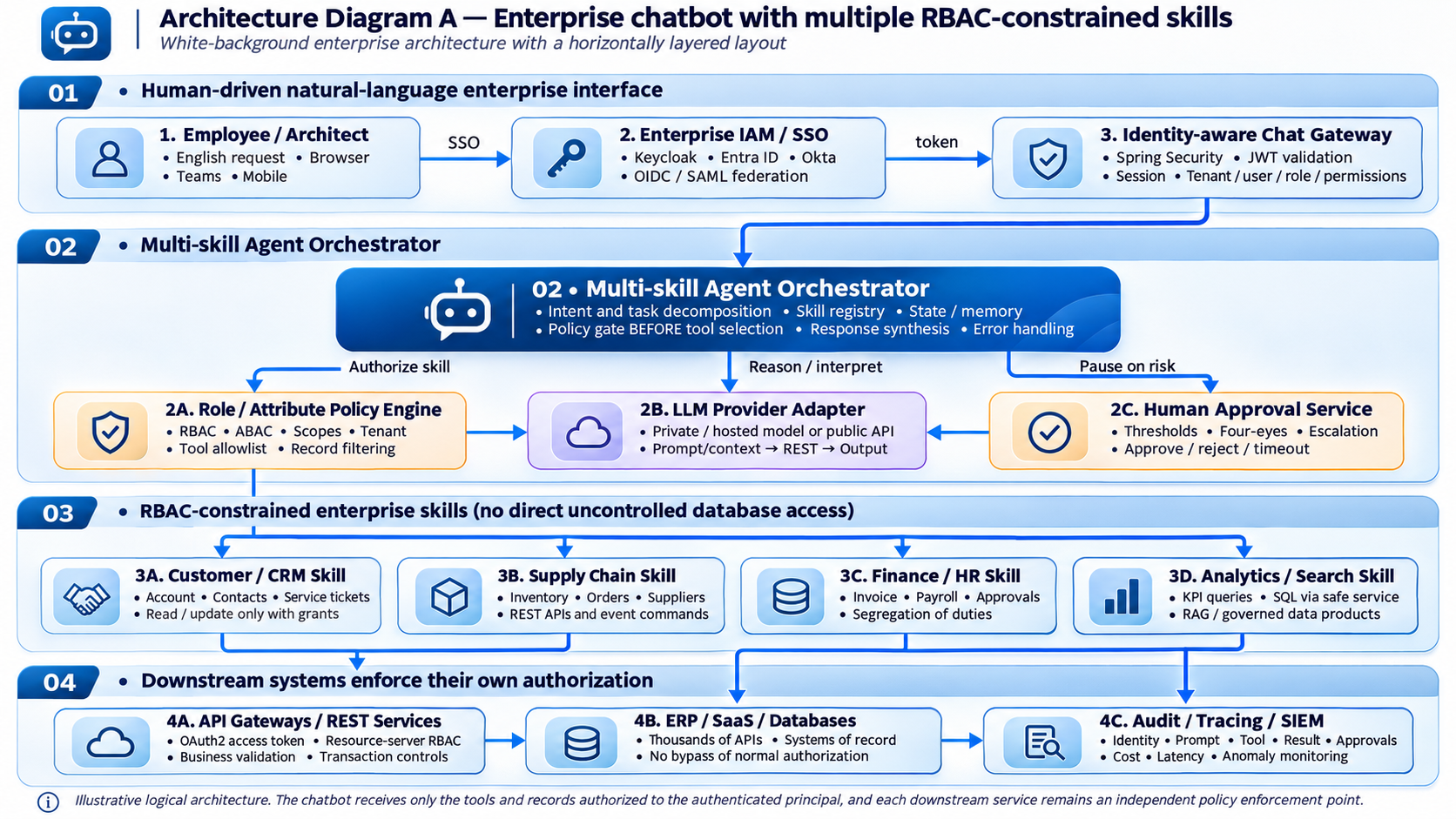
Architecture diagram A — Enterprise chatbot with multiple RBAC-constrained skillsPNG • left-to-right enterprise architecture
Architecture diagram A: Enterprise chatbot with identity-aware SSO, RBAC-constrained skills, LLM reasoning, human approvals, enterprise APIs and auditing
Illustrative logical architecture. Keycloak may serve as an identity broker for Entra ID/Okta; deployment-specific trust relationships vary. The chatbot receives only the tools and records authorized to the authenticated principal, and each downstream service remains an independent policy enforcement point.
Security principle: A user with permission to view store inventory must not gain access to payroll, supplier bank accounts or global purchase approvals merely by typing an English request. RBAC and attribute-based policies must be checked by the tool gateway and underlying enterprise APIs, not inferred from the model's response.
03 / AN AI WORKFORCE — SOFTWARE WORKERS, NOT MAGIC EMPLOYEES

Agentic AI employees. Reason with LLMs, act through governed enterprise APIs.

An “AI employee” is a convenient analogy for a persistent, specialized software worker. Like a traditional job processor or daemon, it may run continuously or on a schedule. Unlike a fixed rules-only program, it can ask an LLM to interpret unstructured information, choose among permitted tools and adapt the next step. It is still accountable to people and application controls.

How an AI worker uses an LLM engine

  • Model selection: A privately hosted/owned model or a public cloud LLM service is exposed through a model endpoint, commonly an HTTPS REST API.
  • Context preparation: The worker sends task instructions, policy-safe context and a constrained tool catalog—not unrestricted enterprise credentials.
  • Reasoning and planning: The model returns proposed next steps, explanations or structured tool-call arguments. These are untrusted proposals until validated.
  • Controlled execution: Application code verifies schemas, permissions, thresholds and business rules before invoking domain REST APIs or MCP-backed tools.
  • State and iteration: The worker records returned facts, retries according to policy, correlates information and determines whether the goal is complete.

Where its enterprise knowledge and skills come from

  • Skills: Versioned adapters for CRM, inventory, vendor portals, ERP, document search, analytics and messaging.
  • Identity: Scoped service credentials or appropriately delegated user tokens with explicit client and tenant authorization.
  • Reliable facts: Read-only enterprise APIs, SQL exposed through governed services, approved knowledge stores and analytics products.
  • Execution: REST API operations, command services, RabbitMQ events and business workflows with idempotency and audit.
  • Guardrails: Deterministic limits, human approvals, logging, evaluation, incident response and emergency stop/disablement.

Concrete example: an AI workforce for an HVAC services company

A customer requests urgent cooling repair. The intake worker classifies the problem and logs a ticket; the dispatch worker checks technician availability; the inventory worker looks up replacement parts; the procurement worker prepares a supplier order; the finance worker drafts an estimate and monitors receivables. All workers use the same enterprise systems that human employees use—through scoped APIs, business rules and recorded actions.

If a replacement compressor exceeds the purchasing limit, the procurement worker pauses and sends a purchasing manager a clear approval request with the parts list, price and customer impact. It cannot self-approve or split transactions to evade that threshold.

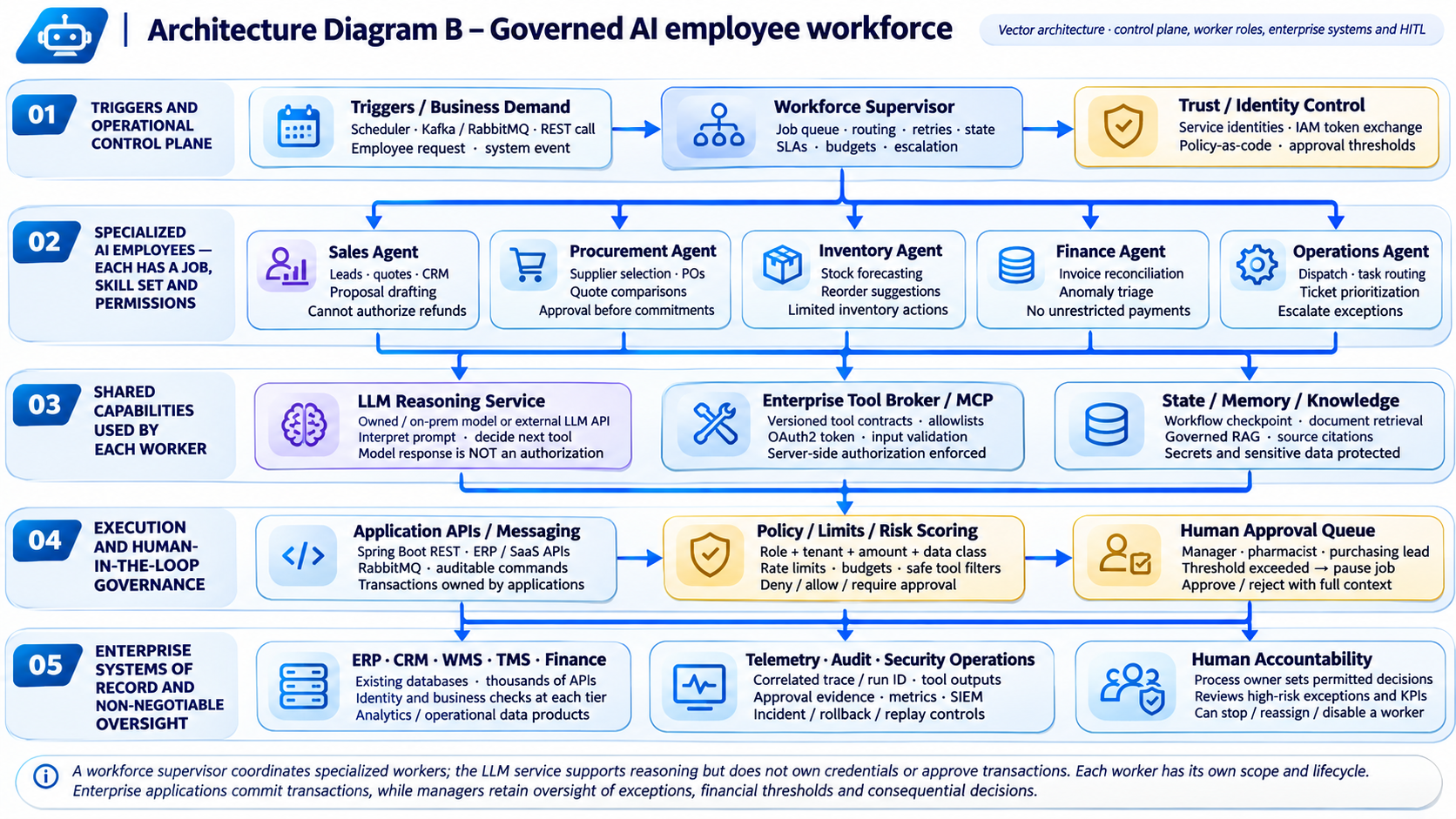
Architecture diagram B — Governed AI employee workforcePNG • AI workforce, enterprise systems and HITL
Architecture diagram B: Governed AI employee workforce with specialized workers, shared LLM and tools, policy checks, human approval, enterprise systems and audit
A workforce supervisor coordinates specialized workers; the LLM service supports reasoning but does not own credentials or approve transactions. Each worker has its own scope and lifecycle. Enterprise applications commit transactions, while managers retain oversight of exceptions, financial thresholds and consequential decisions.

What can safely be automated?

  • Classifying inbound requests and extracting structured fields.
  • Retrieving permitted data, comparing quotes and preparing summaries.
  • Creating draft tickets, purchase orders and scheduling recommendations.
  • Executing low-risk, explicitly authorized tasks below policy thresholds.
  • Monitoring job progress and escalating exceptions.

When must a human remain in the loop?

  • Purchases, refunds or contract commitments above configured limits.
  • Sensitive HR or medical decisions, regulated advice and high-impact changes.
  • Cross-tenant access requests, elevated privileges or policy overrides.
  • Low-confidence, contradictory or incomplete source information.
  • Unusual failures, suspected prompt injection and new/unapproved tools.
Enterprise architect's takeaway: AI workers do not replace security architecture, databases, APIs, message queues, workflows, monitoring or business ownership. They add a reasoning and orchestration capability to those existing investments. Their success is measured by correct, authorized and auditable business outcomes—not how convincingly they sound human.
ENTERPRISE AI ARCHITECTURE · SECURITY · DEVSECOPS · OPERATIONS

LLMOps is not a free pass around enterprise architecture.

An AI agent can understand English, choose tools and coordinate autonomous work. None of those capabilities grants permission to bypass enterprise identity, authorization, change control, deployment standards or operational oversight. The LLM is a reasoning component—not a new security authority or an exemption from the software lifecycle.

The same security. The same RBAC. The same least privilege. The same CI/CD. The same Kubernetes. The same enterprise observability.

Whether an application serves a browser, processes Kafka events, exposes REST APIs or coordinates an AI workforce, its production execution must remain inside the organization's approved security and operations model. More autonomy demands more governance—not less.

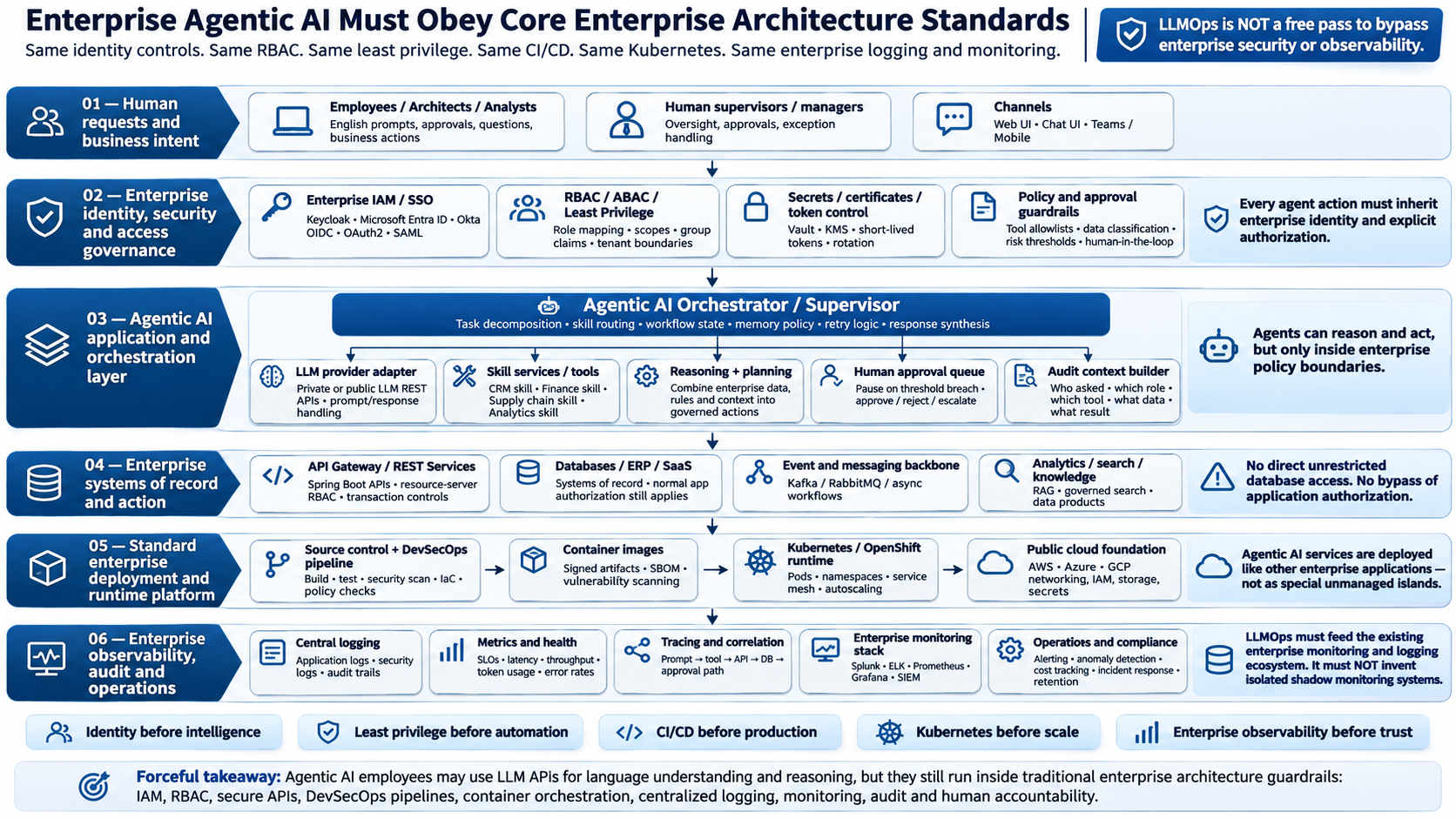
Enterprise Agentic AI governance architecture showing human requests, centralized enterprise IAM and RBAC, AI orchestration, authorized enterprise APIs, DevSecOps and Kubernetes deployment, and centralized Splunk, ELK, Prometheus, Grafana and security monitoring.
Enterprise Agentic AI must remain part of the established enterprise software estate. This diagram connects identity, least privilege, orchestration, enterprise APIs, DevSecOps, container platforms, centralized telemetry, audit and human accountability.

Six non-negotiable enterprise architecture controls

01 / IDENTITY FIRST

Every human and AI workload has a verifiable identity

Continue using enterprise IAM such as Keycloak or Microsoft Entra ID. Use OAuth 2.0/OIDC where appropriate, workload identities, short-lived credentials and managed secrets. Propagate an authorized user's context only through approved delegation patterns; do not let an agent impersonate a user by copying claims or sharing passwords.

02 / PERMISSION BEFORE ACTION

RBAC, ABAC and least privilege remain mandatory

Authorize every skill and tool invocation against the caller, worker identity, tenant, resource and action. An agent that may read purchase orders is not automatically authorized to create, approve or pay them. Downstream REST services must independently enforce access and business rules; an LLM answer is never an authorization decision.

03 / NO SHORTCUT TO SYSTEMS OF RECORD

Thousands of APIs are controlled capabilities—not unrestricted agent privileges

Expose ERP, CRM, WMS, TMS, finance, HR and analytics functions through approved API gateways, versioned tool contracts and resource-server security. Enforce transaction validation, data classification, auditability, rate limits and segregation of duties. Do not grant direct, uncontrolled production database access simply because an agent can generate SQL.

04 / STANDARD SOFTWARE DELIVERY

AI applications follow the existing DevSecOps pipeline

Store agent code, prompts, policies, tool definitions and infrastructure configuration in version control. Apply peer review, CI tests, security scans, dependency and container-image scanning, SBOMs, artifact provenance, environment promotion and approved rollback procedures. Evaluate model and prompt behavior as additional release gates—not as substitutes for ordinary application testing.

05 / GOVERNED RUNTIME

Run production agents on managed enterprise platforms

Deploy orchestrators, gateways and worker services as governed workloads on approved public-cloud platforms and, where appropriate, Kubernetes/OpenShift. Enforce namespace isolation, workload identity, network policies, secrets management, resource quotas, autoscaling, admission controls and disaster recovery. External LLM REST endpoints are dependencies, not a reason to create an unmanaged shadow runtime.

06 / ENTERPRISE OPERATIONS

Feed existing logging, metrics, tracing and incident-response systems

Ship agent events into approved enterprise telemetry pipelines: Splunk or ELK for searchable logs; Prometheus for metrics; Grafana for dashboards; enterprise tracing/APM and SIEM for correlation and detection. Attach request, run, tool, actor and approval identifiers. Apply redaction, access controls and retention policies to sensitive prompts, outputs and retrieved records.

What LLMOps adds—and what it cannot replace

LLMOps-specific responsibilityExisting enterprise discipline that still owns the control
Prompt, model and tool-version trackingVersion control, change management, release governance and deployment traceability
Model evaluation, hallucination checks and safety testingQuality engineering, model-risk governance, security testing and production acceptance criteria
Token use, inference cost, latency and model availabilityEnterprise metrics, SLO dashboards, capacity management, cost governance and incident response
Agent traces, tool calls, memory access and decision evidenceCentralized logs, distributed tracing, SIEM, data-protection controls and audit retention
Autonomous action thresholds and HITL approval checkpointsRBAC/ABAC, approval workflow, segregation of duties, transaction limits and accountable business owners
LLMOps extends DevSecOps and enterprise operations. It does not supersede them.

The responsible architecture is one governed production estate: enterprise IAM authorizes work; conventional APIs execute transactions; approved CI/CD deploys agent services; managed infrastructure runs them; enterprise observability records what happened; and humans retain authority over consequential decisions. A separate AI-only dashboard may be useful, but an isolated shadow monitoring and security estate is not an acceptable substitute for organizational controls.
CORE CAPABILITIES

Beyond impressive demos. Into responsible systems.

LLMs add language reasoning and tool selection, but durable enterprise systems still require conventional engineering disciplines.

Business process blueprint and task workflow illustration

Business task design

Define the task, operating context, expected outputs and limits of AI decision authority.

Enterprise IAM identity verification and authorization shield illustration

Agent identity & authorization

Control which APIs, records and actions each agent can access on behalf of a user or service.

Connected enterprise workflow orchestration hub illustration

Workflow orchestration

Separate state, deterministic controls, task coordination and long-running operations.

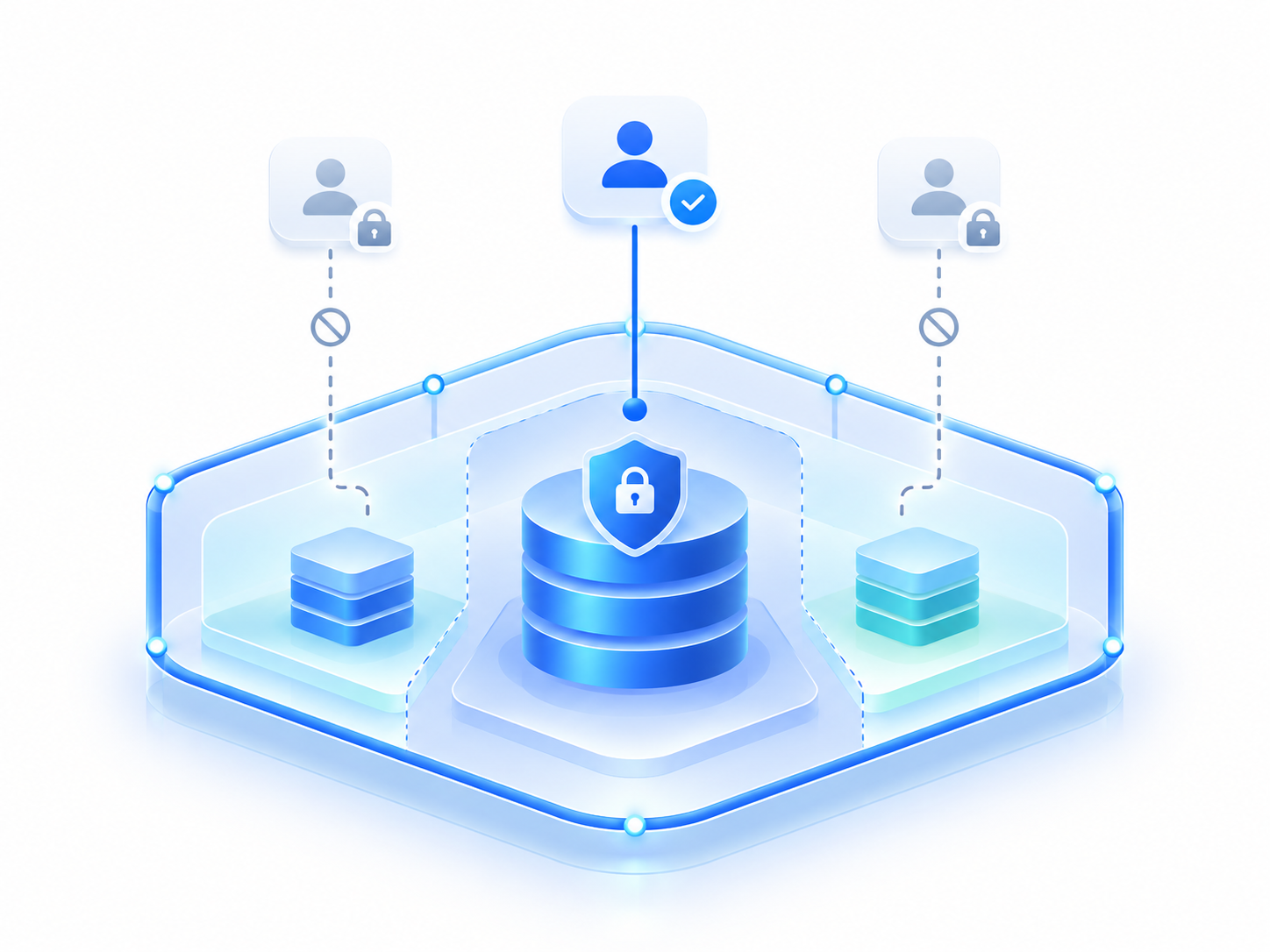
Protected databases and controlled data boundary illustration

Data boundaries

Protect sensitive and regulated records using least privilege and validated tool contracts.

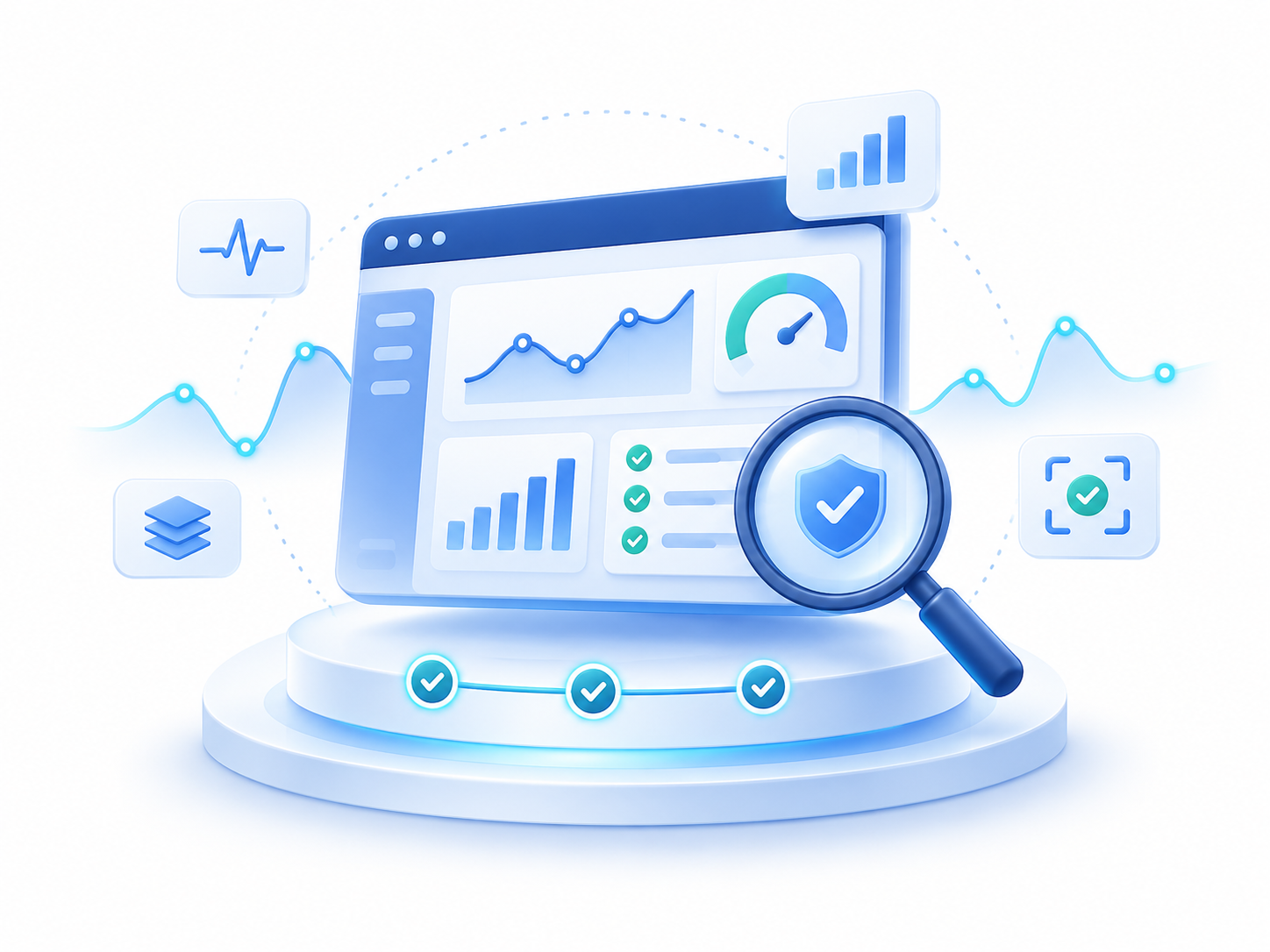
Enterprise observability metrics and evaluation dashboard illustration

Observability & evaluation

Capture action traces, policy decisions, quality checks and incident response signals.

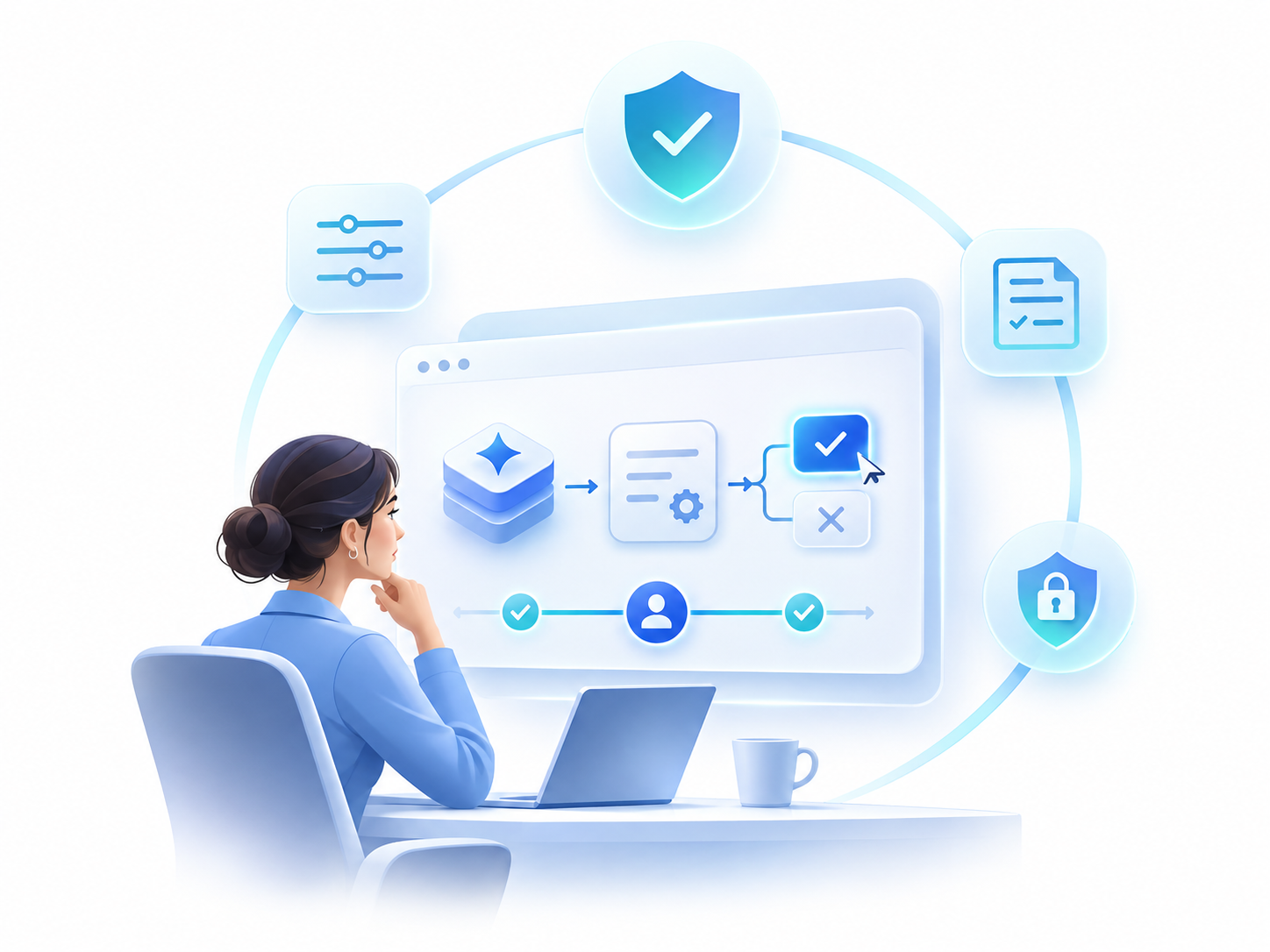
Human reviewer governing an AI workflow and approval decision illustration

Human oversight

Require review or approval for consequential actions and define recovery paths.

REFERENCE ARCHITECTURE

A secure enterprise agent workflow.

A conceptual security-aware pattern. Technical implementation varies with each case study.

HUMAN / APPLICATIONAuthenticated request · Business intent · Context
SECURITY GATEWAYOIDC / OAuth2 · Authorization · Rate limits
AGENT ORCHESTRATIONState machine · Policies · Model interaction
TOOLS / SERVICESScoped REST APIs · Data access · Audit trail
GOVERNANCEEvaluation · Human approval · Metrics · Incident response
PERSONALIZED PROFESSIONAL DEVELOPMENT · ENTERPRISE AGENTIC AI

Learn to architect AI agents inside the real enterprise.

Rolling Stone Technology offers in-depth, personalized Agentic AI architecture learning for experienced developers, solution architects, enterprise architects, technical leaders and engineering teams. The objective is not merely to build a chatbot demo. It is to design and govern AI-enabled software that works with complex business processes, existing enterprise applications, security controls and production operations.

Enterprise architecture first. Agentic AI capabilities within it — never outside it.

Working AI agents must authenticate, operate within explicit authorization boundaries, invoke secured APIs, respect business transaction rules, pass normal DevSecOps release gates and emit telemetry into the enterprise's existing monitoring and security systems. LLMOps is an additional engineering discipline, not permission to bypass IAM, RBAC, least privilege, Kubernetes governance or enterprise observability.

01

Business systems & cross-functional integration

Map operating models, information ownership and business events. Connect AI agents to the enterprise's existing REST APIs, event streams, ERP/CRM applications, databases and analytics through governed service interfaces, not unrestricted database access.

02

Identity, authorization & human accountability

Apply OAuth2/OIDC, Keycloak or Microsoft Entra ID integration, service identities, delegated authorization, tenant isolation, RBAC/ABAC, least-privilege tool access, transaction limits, audit trails and human-in-the-loop approvals.

03

DevSecOps, Kubernetes & enterprise observability

Build and deploy containerized agents through established CI/CD and security pipelines. Cover Kubernetes/OpenShift, public-cloud operations, tracing, evaluation and integration with Splunk, ELK, Prometheus, Grafana and existing security monitoring practices.

Personalized learning across real business verticals.

Each industry program begins with a concrete operating problem and produces a realistic, security-aware agentic architecture and proof of concept. Scope and depth are tailored to your role, experience and business domain.

Manufacturing & ERP

Production planning, materials, quality, purchasing and finance agents integrated with manufacturing ERP and approval workflows.

Retail & E-Commerce

Inventory optimization, demand signals, order fulfillment, customer operations and policy-controlled replenishment.

Supply Chain & Logistics

Procurement, supplier collaboration, warehouse operations, transportation and governed exception resolution.

Healthcare & Insurance

Role-aware care operations, patient and claims workflows, protected information and human clinical oversight.

Banking & Financial Services

Customer servicing, fraud investigation support, reconciliations, segregation of duties and financial approval thresholds.

Telecommunications

Service provisioning, ticket triage, customer lifecycle management, network incident coordination and billing.

Government & Regulated SaaS

Strong IAM, tenant boundaries, evidence collection, auditability, compliance controls and governed AI workflows.

Mining, Utilities & Field Services

Asset maintenance, field dispatch, work orders, equipment availability, inventory and risk-based escalations.

What the personalized program can cover

  • Business process discovery and agent opportunity assessment
  • Multi-skill chatbot and autonomous AI workforce design
  • Agent identity, OAuth2/OIDC, RBAC/ABAC and tool authorization
  • Enterprise REST API, messaging and governed data integration
  • HITL checkpoints, policy limits, audit and safe failure handling
  • CI/CD, container deployment and Kubernetes operations
  • Splunk/ELK logging, Prometheus/Grafana metrics and tracing
  • Reference architecture diagrams and working POC deliverables
DISCUSS A PERSONALIZED PROGRAM

Move beyond AI demonstrations. Learn to deliver enterprise-ready Agentic AI.

Tell us your current role, industry, existing enterprise platforms, security requirements and learning objectives. We can discuss an individualized architecture curriculum, hands-on case studies and the scope of a working proof of concept.

Personalized learning is available by inquiry. Program content, format and arrangements are discussed individually; no accreditation or guaranteed outcome is implied.