ENTERPRISE AI ARCHITECTURE · SECURITY · DEVSECOPS · OPERATIONS
LLMOps is not a free pass around enterprise architecture.
An AI agent can understand English, choose tools and coordinate autonomous work. None of those capabilities grants permission to bypass enterprise identity, authorization, change control, deployment standards or operational oversight. The LLM is a reasoning component—not a new security authority or an exemption from the software lifecycle.
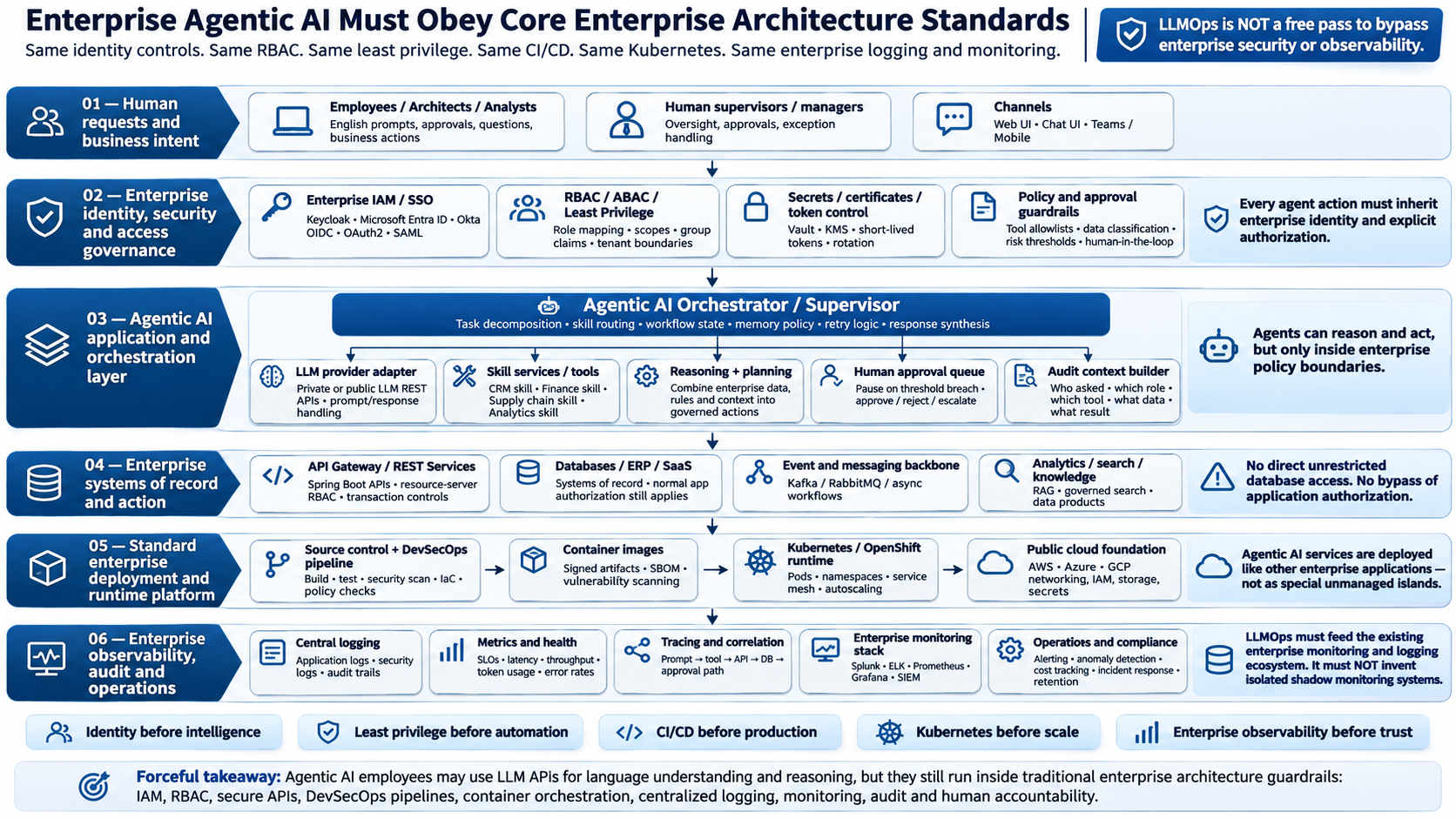
The same security. The same RBAC. The same least privilege. The same CI/CD. The same Kubernetes. The same enterprise observability.
Whether an application serves a browser, processes Kafka events, exposes REST APIs or coordinates an AI workforce, its production execution must remain inside the organization's approved security and operations model. More autonomy demands more governance—not less.
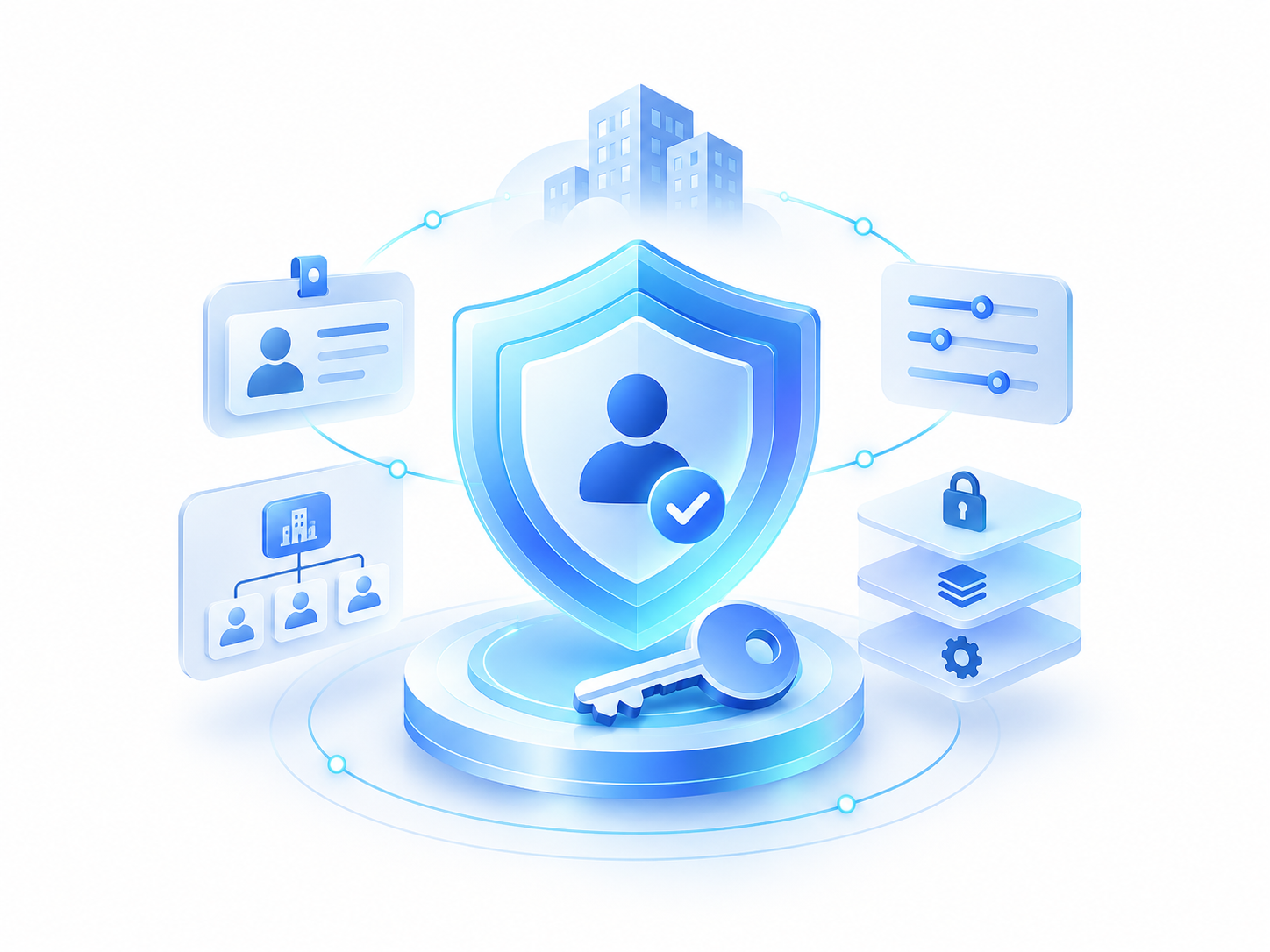
01 / IDENTITY FIRSTEvery human and AI workload has a verifiable identity
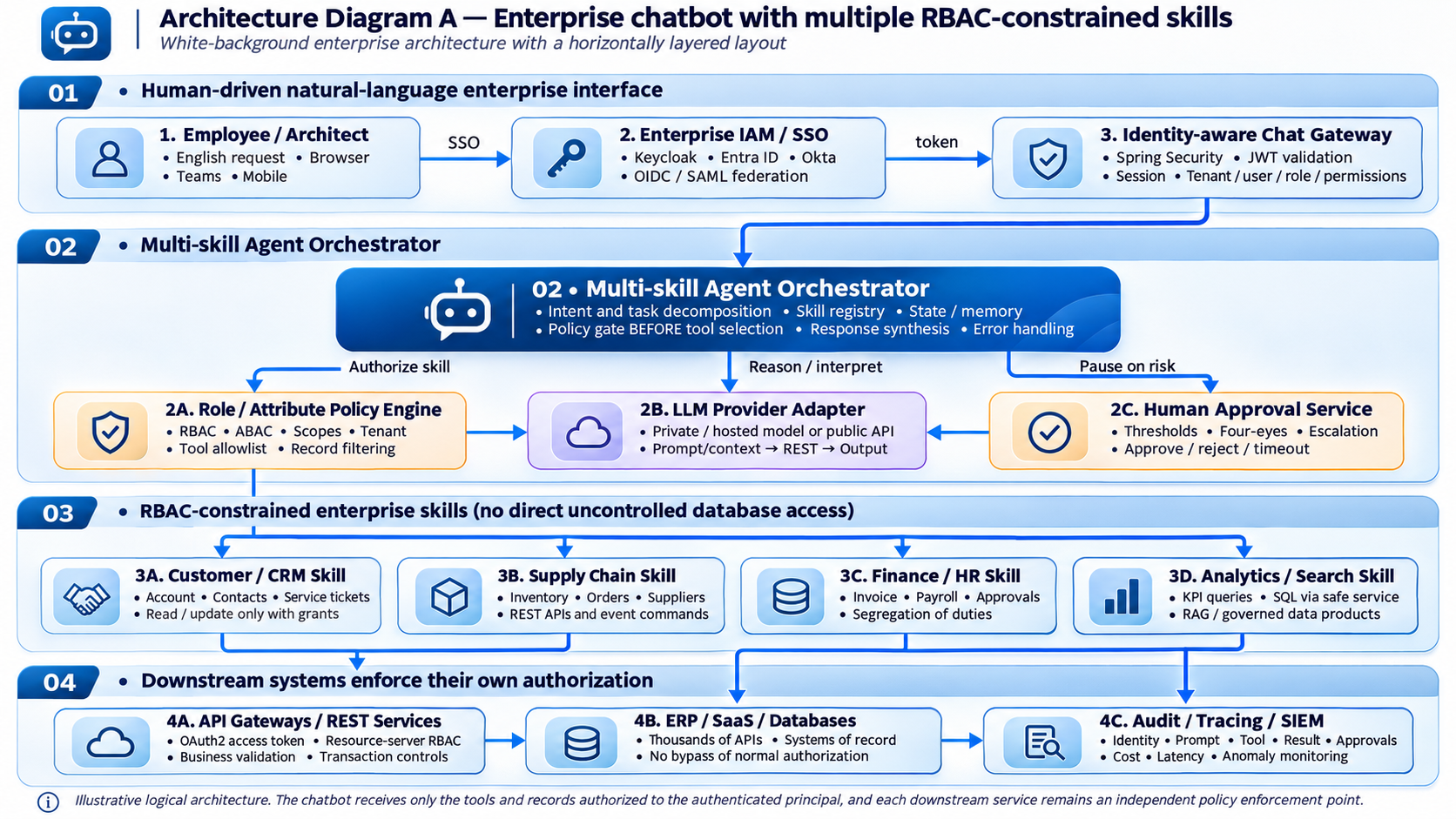
Continue using enterprise IAM such as Keycloak or Microsoft Entra ID. Use OAuth 2.0/OIDC where appropriate, workload identities, short-lived credentials and managed secrets. Propagate an authorized user's context only through approved delegation patterns; do not let an agent impersonate a user by copying claims or sharing passwords.
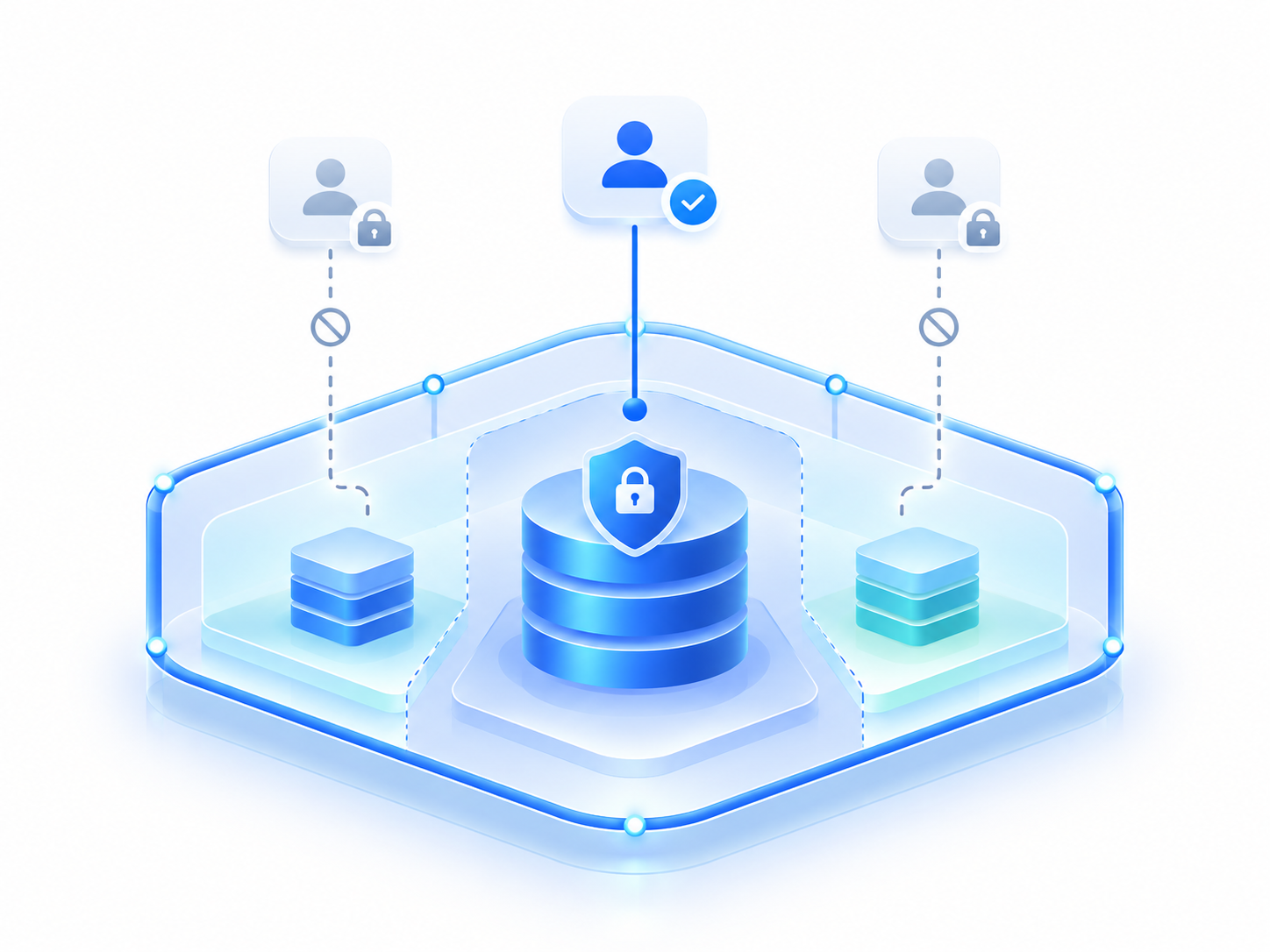
02 / PERMISSION BEFORE ACTIONRBAC, ABAC and least privilege remain mandatory
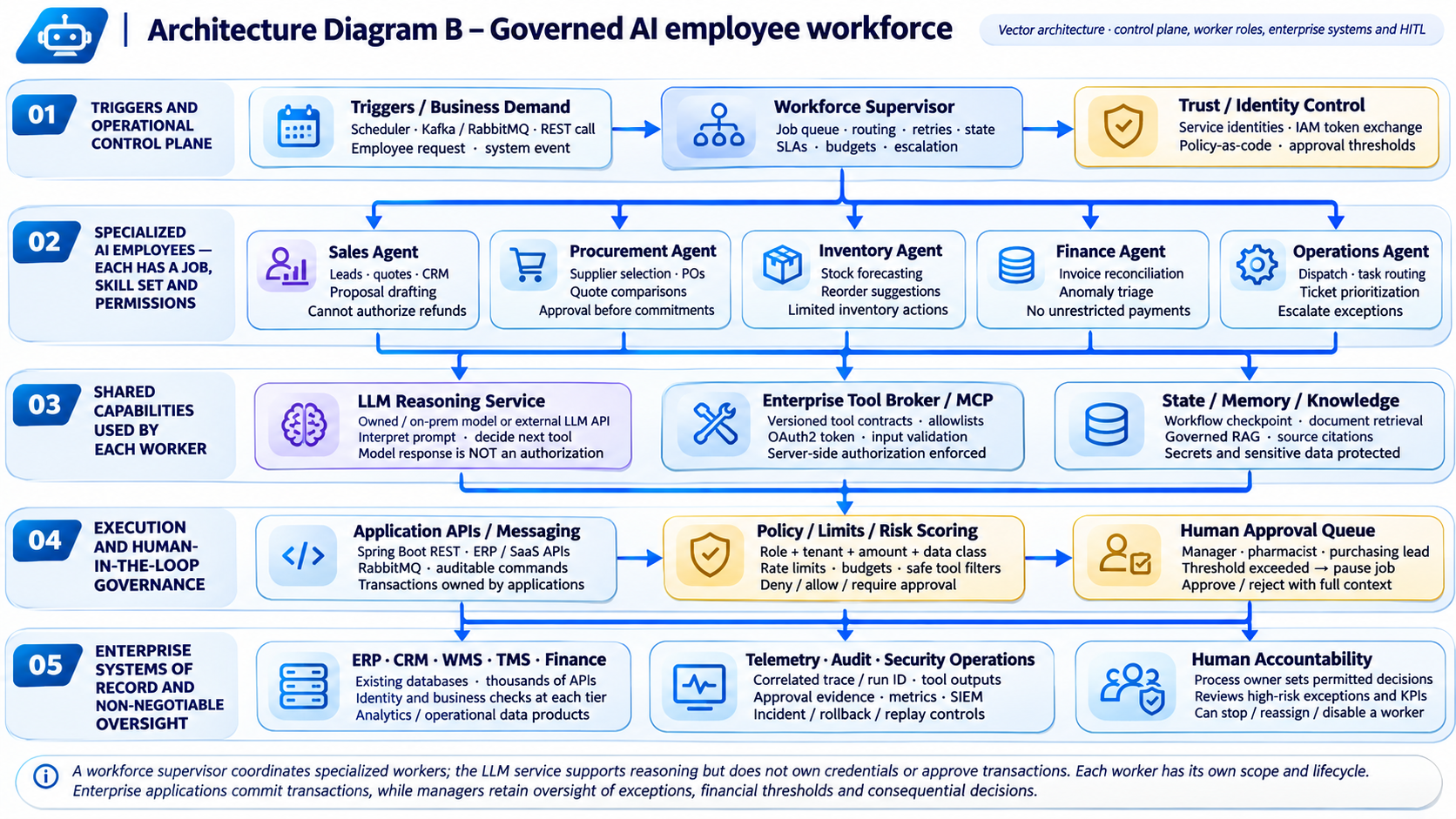
Authorize every skill and tool invocation against the caller, worker identity, tenant, resource and action. An agent that may read purchase orders is not automatically authorized to create, approve or pay them. Downstream REST services must independently enforce access and business rules; an LLM answer is never an authorization decision.
03 / NO SHORTCUT TO SYSTEMS OF RECORDThousands of APIs are controlled capabilities—not unrestricted agent privileges
Expose ERP, CRM, WMS, TMS, finance, HR and analytics functions through approved API gateways, versioned tool contracts and resource-server security. Enforce transaction validation, data classification, auditability, rate limits and segregation of duties. Do not grant direct, uncontrolled production database access simply because an agent can generate SQL.
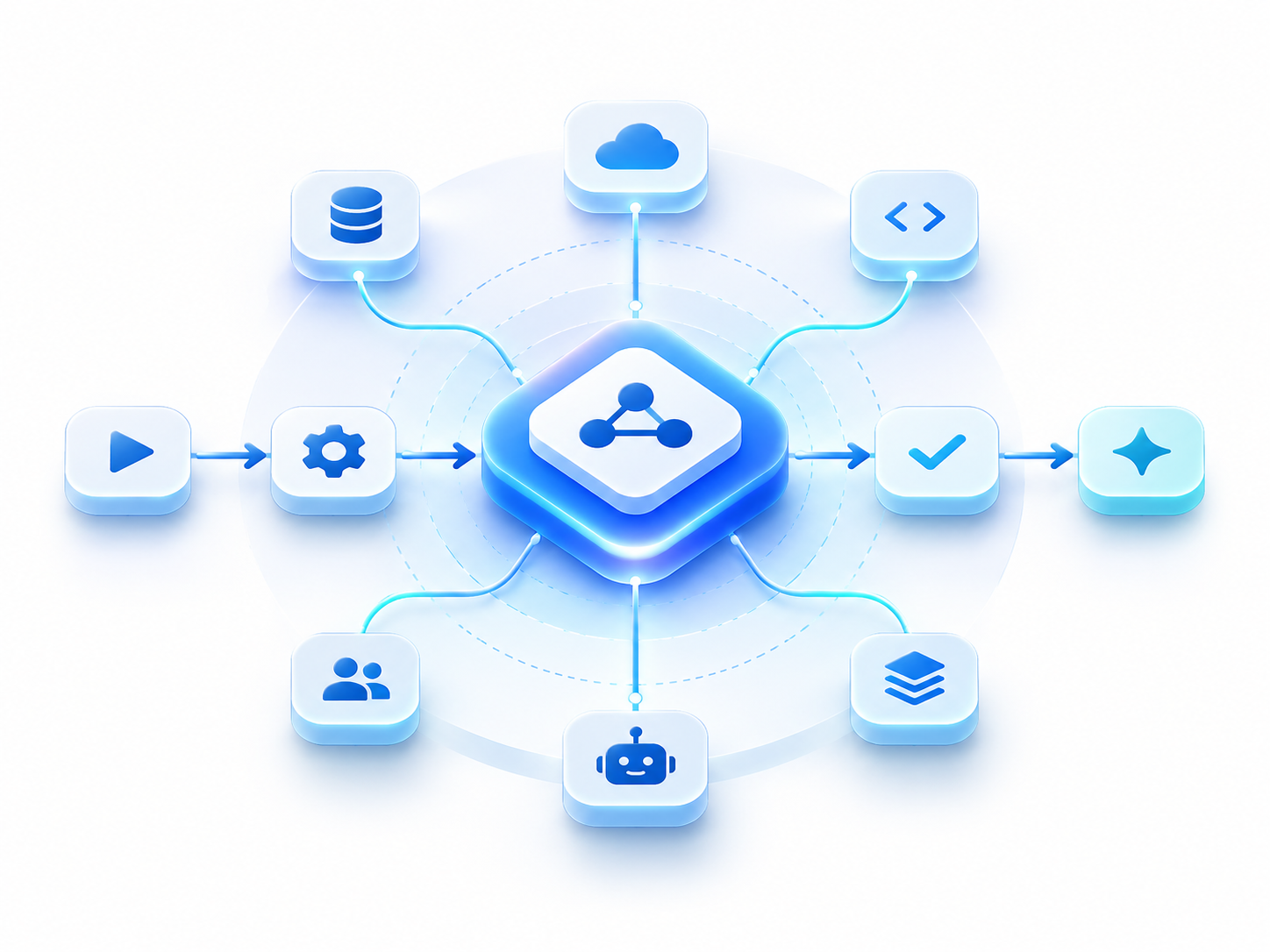
04 / STANDARD SOFTWARE DELIVERYAI applications follow the existing DevSecOps pipeline
Store agent code, prompts, policies, tool definitions and infrastructure configuration in version control. Apply peer review, CI tests, security scans, dependency and container-image scanning, SBOMs, artifact provenance, environment promotion and approved rollback procedures. Evaluate model and prompt behavior as additional release gates—not as substitutes for ordinary application testing.
05 / GOVERNED RUNTIMERun production agents on managed enterprise platforms
Deploy orchestrators, gateways and worker services as governed workloads on approved public-cloud platforms and, where appropriate, Kubernetes/OpenShift. Enforce namespace isolation, workload identity, network policies, secrets management, resource quotas, autoscaling, admission controls and disaster recovery. External LLM REST endpoints are dependencies, not a reason to create an unmanaged shadow runtime.
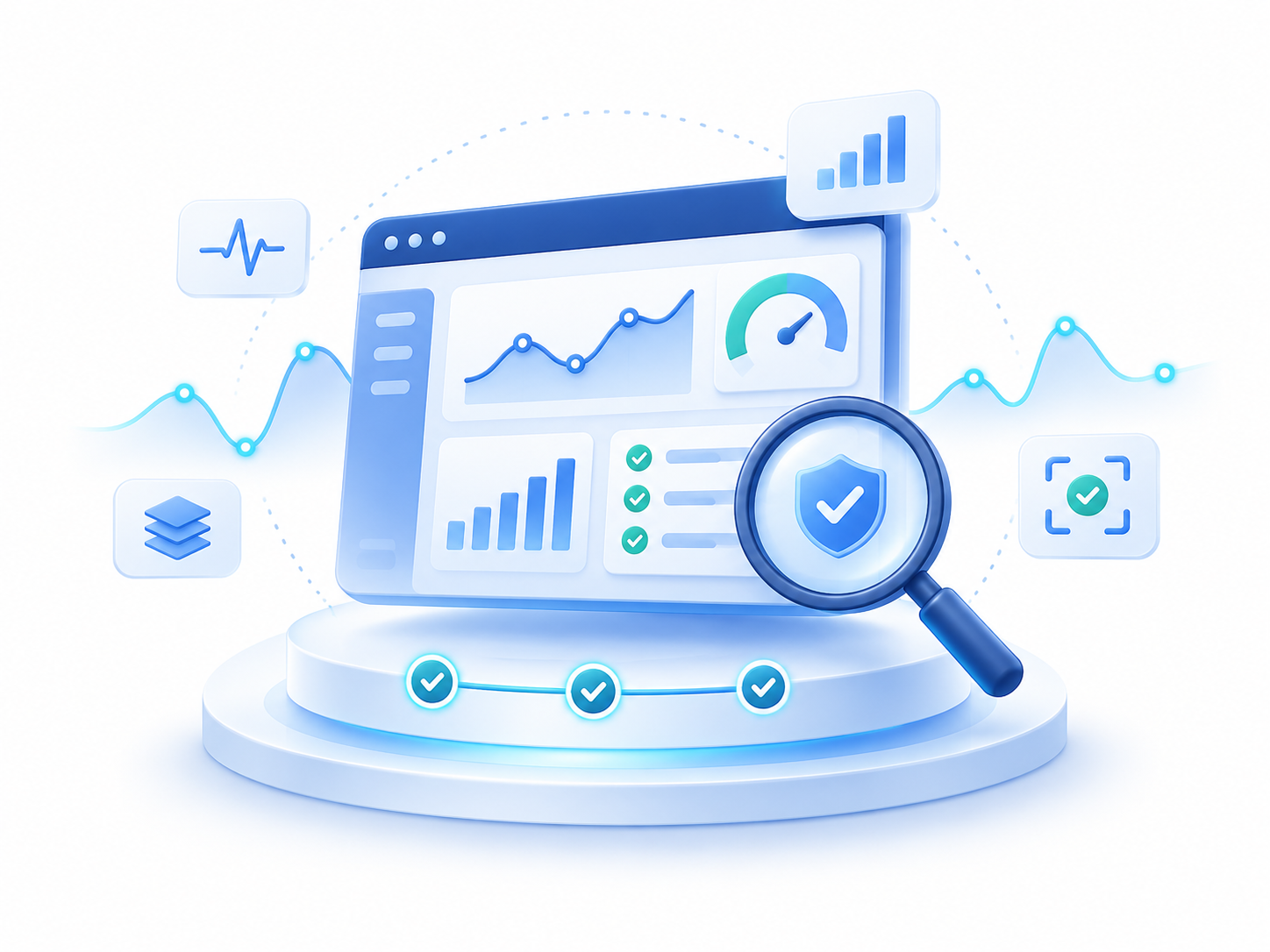
06 / ENTERPRISE OPERATIONSFeed existing logging, metrics, tracing and incident-response systems
Ship agent events into approved enterprise telemetry pipelines: Splunk or ELK for searchable logs; Prometheus for metrics; Grafana for dashboards; enterprise tracing/APM and SIEM for correlation and detection. Attach request, run, tool, actor and approval identifiers. Apply redaction, access controls and retention policies to sensitive prompts, outputs and retrieved records.
LLMOps extends DevSecOps and enterprise operations. It does not supersede them.The responsible architecture is one governed production estate: enterprise IAM authorizes work; conventional APIs execute transactions; approved CI/CD deploys agent services; managed infrastructure runs them; enterprise observability records what happened; and humans retain authority over consequential decisions. A separate AI-only dashboard may be useful, but an isolated shadow monitoring and security estate is not an acceptable substitute for organizational controls.